
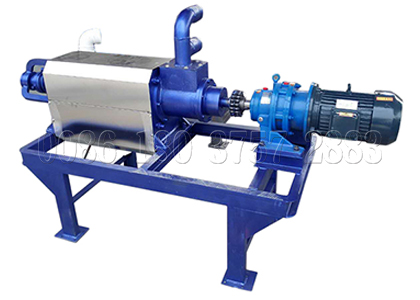
Yüksek nemli organik atıklarla uğraşmak için, ilk adım fazla suyu uzaklaştırmaktır. Bu tür organik atıklar inek gübresini içerir, domuz gübresi ve bazı çiftlik atıkları. Vidalı ekstrüzyon ile, Organik atıkların dehidrasyonunu gerçekleştirebilir. Tongda iki tip gübre ayırıcı üretiyor, katı sıvı ayırıcı ve katı sıvı ayrımı için eğimli elek. Deneyimlerimize göre, aşağıdaki soruları özetliyoruz. Ve bunların sizin için yararlı olacağını umuyoruz.

1. Gübre ayırıcının kapasitesi nedir?
The input of organic waste: 8-15 metreküp bölü saat.
Susuz organik atık çıktısı: 1.5-3 metreküp bölü saat.
2. What’s the materials of the whole machine?
All parts that contact with organic waste adopt SUS 304 ( such as hopper screen and auger).
3. Is it adopts explosion-proof motor ?
Evet.
4. Is the pressure (dehydrating level) increased by hand with tools or is it electric ?
You need to adjust the pressure of manure separator by hand with tools.
5. What’s the moisture of organic waste after dehydrating?
Genel olarak konuşursak, it ranges from 25% ile 40%. But you can adjust it according to your actual requirements.
6. What’s the hp of electric motor and the available voltage(110 V/220 V)?
The motor power is 4 Kw. The voltage can be designed and adjusted according your requirements.
7. What’s the size of liquid outlet hole?
Its diameter is 76 mm.
8. What’s the size of screen mesh?
Onun boyutu 0.3-0.5 mm. And the customized size can achieve 0.1-0.3 mm.
9. Where can I use separated liquid from animal manure?
You can make bio-gas from it.
10. How to deal with organic waste after dewatering?
You can make a compost pile and produce organic waste compost, which can be used as organic fertilizer. Daha sonra, you can make bagged fertilizer powder or pellets for commercial purpose.
Not: Kompostlama sırasında, the content of animal manure is at least 60%.