
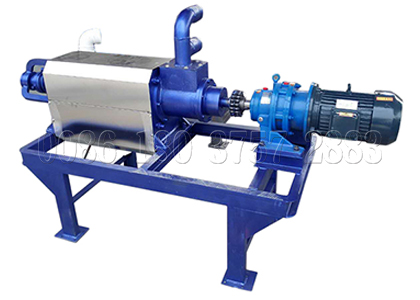
Para tratar residuos orgánicos con alto contenido de humedad., El primer paso es eliminar el exceso de agua.. Este tipo de residuos orgánicos incluye el estiércol de vaca., estiércol de cerdo y algunos desechos agrícolas. Por extrusión de tornillo, Puede realizar la deshidratación de residuos orgánicos.. Tongda produce dos tipos de separadores de estiércol, Separador de líquido sólido y pantalla inclinada para separación de líquido sólido.. Según nuestra experiencia, resumimos las siguientes preguntas. Y esperamos que os sean de utilidad.

1. ¿Cuál es la capacidad del separador de estiércol??
The input of organic waste: 8-15 metros cúbicos por hora.
La salida de residuos orgánicos deshidratados.: 1.5-3 metros cúbicos por hora.
2. What’s the materials of the whole machine?
All parts that contact with organic waste adopt SUS 304 ( such as hopper screen and auger).
3. Is it adopts explosion-proof motor ?
Yes.
4. Is the pressure (dehydrating level) increased by hand with tools or is it electric ?
You need to adjust the pressure of manure separator by hand with tools.
5. What’s the moisture of organic waste after dehydrating?
En general, it ranges from 25% a 40%. But you can adjust it according to your actual requirements.
6. What’s the hp of electric motor and the available voltage(110 V/220 V)?
The motor power is 4 KW. The voltage can be designed and adjusted according your requirements.
7. What’s the size of liquid outlet hole?
Its diameter is 76 milímetros.
8. What’s the size of screen mesh?
Su tamaño es 0.3-0.5 milímetros. And the customized size can achieve 0.1-0.3 milímetros.
9. Where can I use separated liquid from animal manure?
You can make bio-gas from it.
10. How to deal with organic waste after dewatering?
You can make a compost pile and produce organic waste compost, which can be used as organic fertilizer. Entonces, you can make bagged fertilizer powder or pellets for commercial purpose.
Nota: Durante el compostaje, the content of animal manure is at least 60%.