
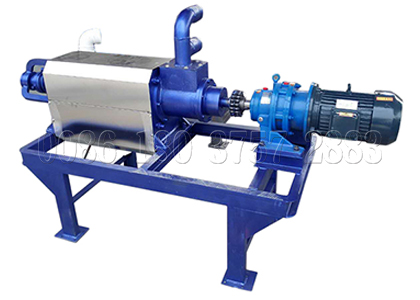
Do postępowania z odpadami organicznymi o dużej zawartości wilgoci, pierwszym krokiem jest usunięcie dodatkowej wody. Do tego rodzaju odpadów organicznych zalicza się obornik krowi, obornik świński i niektóre odpady rolnicze. Przez wytłaczanie śrubowe, może realizować odwodnienie odpadów organicznych. Tongda produkuje dwa typy separatorów obornika, separator cieczy stałej i nachylony ekran do oddzielania cieczy stałej. Według naszego doświadczenia, podsumowujemy następujące pytania. Mamy nadzieję, że będą dla Ciebie przydatne.

1. Jaka jest pojemność separatora obornika?
The input of organic waste: 8-15 metrów sześciennych na godzinę.
Wyjście odwodnionych odpadów organicznych: 1.5-3 metrów sześciennych na godzinę.
2. What’s the materials of the whole machine?
All parts that contact with organic waste adopt SUS 304 ( such as hopper screen and auger).
3. Is it adopts explosion-proof motor ?
Tak.
4. Is the pressure (dehydrating level) increased by hand with tools or is it electric ?
You need to adjust the pressure of manure separator by hand with tools.
5. What’s the moisture of organic waste after dehydrating?
Ogólnie rzecz biorąc, it ranges from 25% Do 40%. But you can adjust it according to your actual requirements.
6. What’s the hp of electric motor and the available voltage(110 V/220 V)?
The motor power is 4 KW. The voltage can be designed and adjusted according your requirements.
7. What’s the size of liquid outlet hole?
Its diameter is 76 mm.
8. What’s the size of screen mesh?
Jego rozmiar jest 0.3-0.5 mm. And the customized size can achieve 0.1-0.3 mm.
9. Where can I use separated liquid from animal manure?
You can make bio-gas from it.
10. How to deal with organic waste after dewatering?
You can make a compost pile and produce organic waste compost, which can be used as organic fertilizer. Następnie, you can make bagged fertilizer powder or pellets for commercial purpose.
Notatka: Podczas kompostowania, the content of animal manure is at least 60%.