Manure to fertilizer machine manufacturer since 2005 info@manuretofertilizer.com | +86 182 0399 3035 | WhatsApp
HomeManure to FertilizerManure Fertilizer Plant Cost
Manure Fertilizer Plant Cost
Budget before you buy

Manure Fertilizer Plant Cost

Two manure fertilizer plants with identical output can differ in price by a factor of three. This page explains exactly what drives that difference, what a plant costs to run, and how to calculate payback honestly.

  • Five cost drivers: manure moisture, product form, capacity, automation and site works
  • Operating cost per tonne broken down into power, fuel, labour and bags
  • How to build a payback calculation your bank will accept

At a glance

Lowest entry point
1–2 t/h powder line, windrow fermentation
Most common order
5 t/h organic granule line with automatic bagging
Largest cost item
Drying system on a granule line; fermentation floor on a powder line
Biggest cost risk
Site works and power supply, not the machinery

Why you cannot price a manure fertilizer plant from a tonnage table

Equipment catalogues quote a price per tonne per hour, and it is misleading. A 5 t/h plant fed dry layer manure that has already been dried on the farm may need only a crusher, mixer, granulator, dryer, cooler and packer. A 5 t/h plant fed dairy slurry at 88% moisture needs a separator, a much larger fermentation area, a dryer sized to remove far more water, and a bigger dust and odour system. The second plant can easily cost twice the first while producing the same tonnage of bags.

The honest way to approach cost is to establish five numbers before asking any supplier for a quotation: the animal and housing system, the daily manure tonnage as produced, the moisture content of that manure, the product form you intend to sell, and the labour and power available on site. With those five answers any competent manufacturer can give you a meaningful budget in a week. Without them, any number you receive is a guess, and it will usually be the lowest one.

Indicative budget bands by plant scale

Use these bands to test whether a project is affordable before spending time on detailed engineering. They cover the complete mechanical and electrical equipment package, ex-works, and exclude civil works, freight, duty and installation.

PlantOutputWhat is in the packageRelative equipment cost
Farm scale powder line1–2 t/hSeparator, self-propelled turner, crusher, screener, packing scale, conveyors1.0 (baseline)
Small commercial powder line3–5 t/hEverything above plus forklift feeder, groove turner, batching, mixer, automatic packer2.0–2.6×
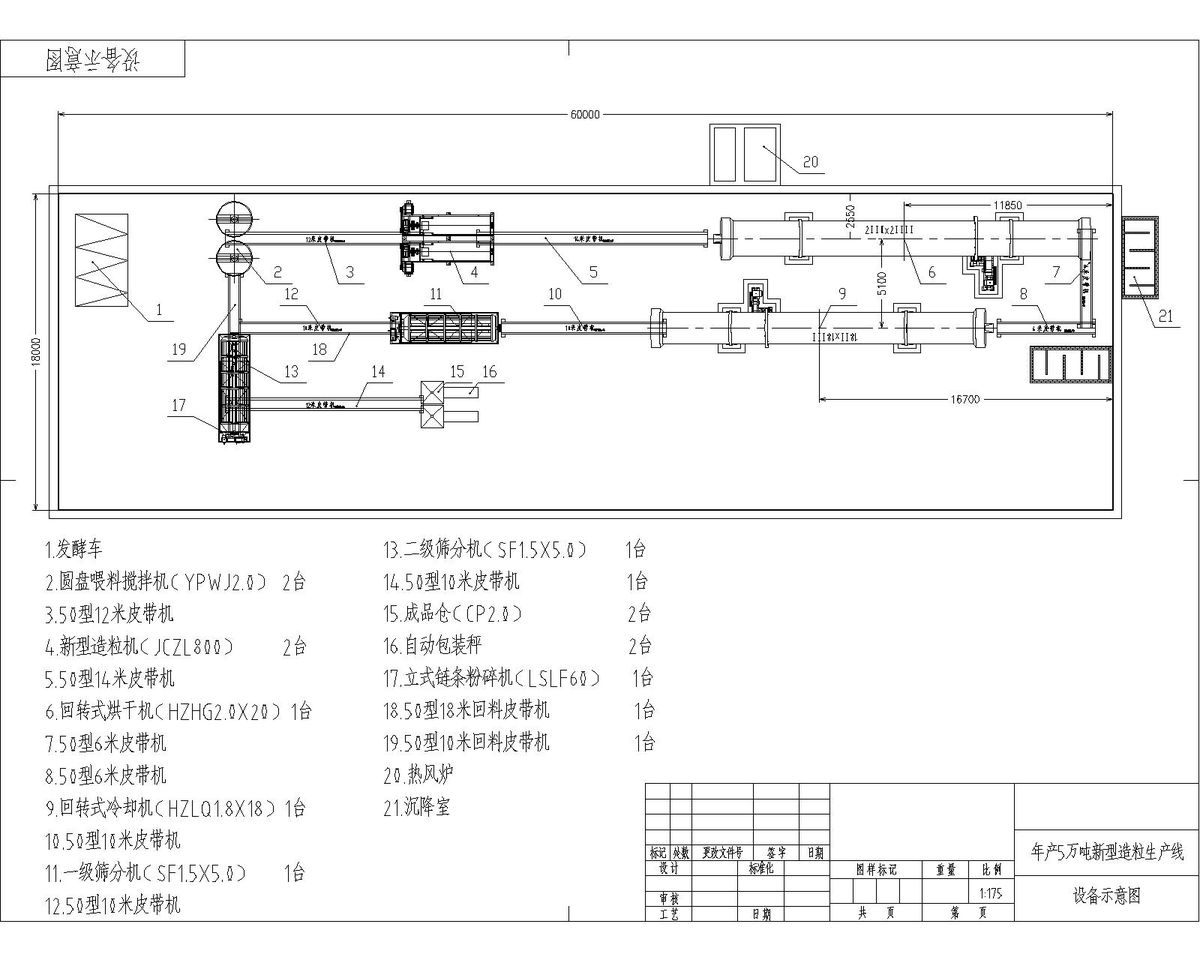
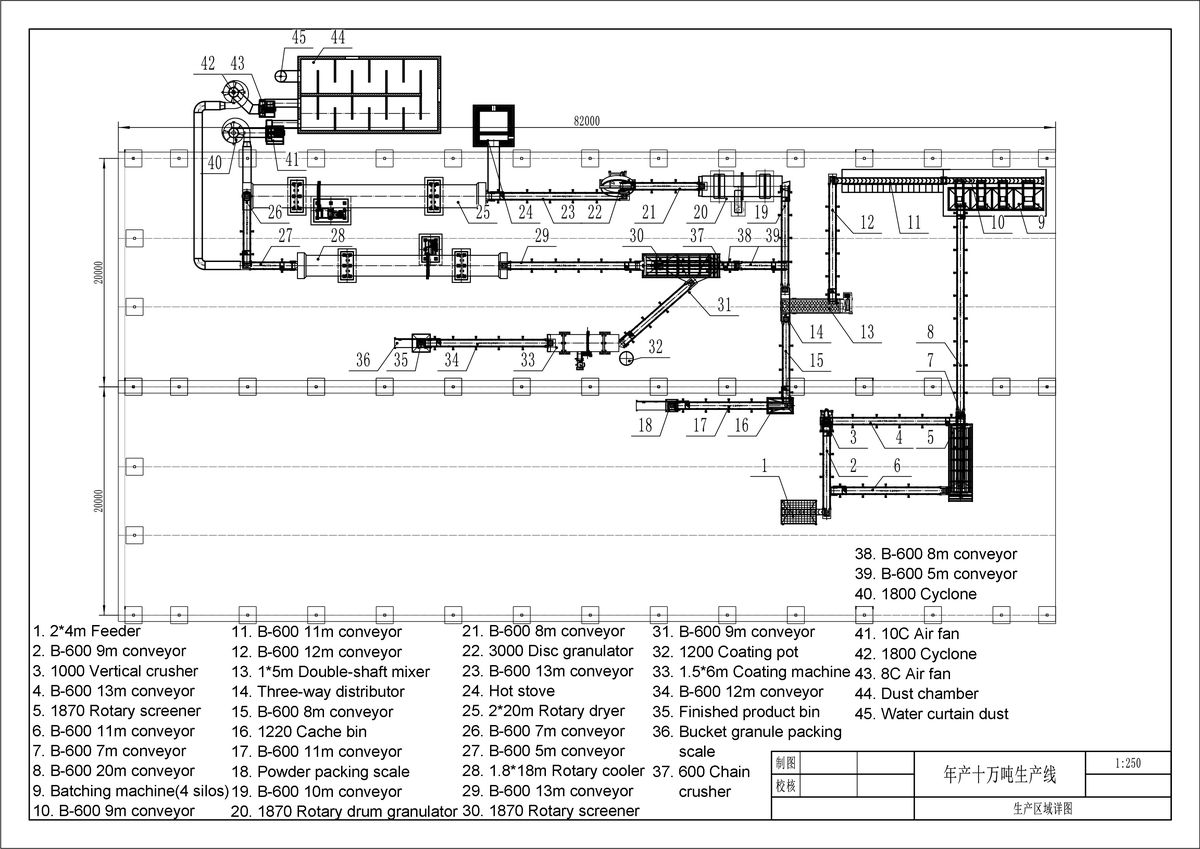
Organic granule line3–5 t/hPowder line plus granulator, rotary dryer, cooler, coater, product screener, larger conveying and dust collection3.0–4.5×
Organic-inorganic granule line10–20 t/hAutomatic multi-silo batching, drum or double roller granulation, large dryer line, PLC control, 50 kg auto packer, palletiser8–14×
Large plant20–30 t/hMultiple fermentation channels or in-vessel fermentation, redundant conveying, full automation, bulk storage18–30×

The five cost drivers

Every one of these can move the equipment budget more than a change in tonnage does. Review them in this order.

1. Manure moisture

1. Manure moisture

Moisture decides how much water must be removed, and drying is the most energy-intensive and most expensive stage in the plant. Going from 80% to 60% moisture by separation is many times cheaper than removing the same water in a dryer.

View details →
2. Product form

2. Product form

Powder stops after screening. Granules add granulation, drying, cooling, coating, a second screener, more conveying, dust collection and a larger electrical supply.

View details →
3. Capacity and running hours

3. Capacity and running hours

Cost scales sub-linearly with tonnage but linearly with machine size. Running two shifts on a smaller line is almost always cheaper than buying a larger line and running one.

View details →
4. Automation level

4. Automation level

Manual batching, hand-fed bagging and visual control cost less to buy and more to run. In most markets the labour saved pays back the automation premium in two to three years.

View details →
5. Site works and utilities

5. Site works and utilities

Concrete fermentation floor, drainage, a covered hall, three-phase power of the right voltage and a hard access road frequently cost more than the machines. They are also the items most often left out of a first budget.

View details →

Operating cost: where the money goes each tonne

  • Power is the largest controllable cost on a granule line, dominated by the crusher, granulator, dryer fan and cooler. Taking the line's connected load and multiplying by the local industrial tariff, divided by real output, gives you cost per tonne within about 10%.
  • Drying fuel matters more than electricity in most countries. Removing water is proportional to the water you must evaporate, so a well-separated, well-drained compost that arrives at the dryer at 35% instead of 45% can cut fuel cost by a third.
  • Labour is a function of the number of machines, not the tonnage. A three-person line producing 2 t/h costs half the labour per tonne of a three-person line producing 1 t/h, which is the strongest economic argument for running a smaller plant at higher utilisation.
  • Bags, thread and pallets are frequently underestimated. Count them properly: a 50 kg bag of organic fertilizer needs a bag, a liner where the product is dusty, thread and a pallet, and those consumables are a real per-tonne cost.
  • Maintenance is dominated by wear parts — screens, crusher teeth, granulator teeth, dryer flights and seals. Budget 2–4% of equipment value per year for a manure line, and keep the fast-wearing items in stock locally.
  • Land lease, working capital to buy raw material where you do not produce it yourself, and the cost of laboratory analysis for product registration are the items most often forgotten in a first-year budget.

Payback: how to calculate it honestly

Payback is not the selling price of fertilizer minus the cost of manure. It is the contribution per tonne — selling price per tonne minus operating cost per tonne — multiplied by real annual output, compared against total project cost including civil works, freight, installation and the working capital you need to carry inventory. Many business plans we see fail on two points: they assume the plant runs at nameplate capacity from month one, and they assume the fertilizer price from a national average rather than from the specific distributor who has agreed to buy.

A realistic model reduces output to 60% of nameplate for the first year and 80–85% thereafter, allows 8–10% product loss in the screens and crusher return circuit, and uses the price you have actually been quoted by a buyer. Under those assumptions, a small powder line producing bulk-blended and bagged organic fertilizer typically pays back in one to two seasons in markets with a working organic fertilizer price; a granule line generally takes three to five years. If your numbers only work at full capacity and full price, the project is a speculation rather than a business.

Frequently asked questions

What is the cheapest way to start producing manure fertilizer?

Compost to a mature product and sell it in bulk, or add a crusher, a screener and a bagging scale and sell powder in bags. Both avoid the granulator, dryer and cooler, which are the three most expensive machines in a plant and the ones that consume the most energy. Many successful producers never install a dryer at all.

Does a bigger plant cost less per tonne?

Yes, for equipment and labour — cost per tonne falls sharply with size because labour and control equipment do not scale linearly. But it rises again if you cannot keep the plant full, because a large line running two days a week has high fixed maintenance and debt service per tonne produced. The sweet spot in most markets is a plant sized to about 70–80% of the manure actually available, running one long shift or two shorter shifts.

How much does installation add to the equipment cost?

For a complete line shipped overseas, allow 8–15% of the equipment value for installation, plus the cost of the engineer's travel, accommodation and local labour. Civil works — foundations, floors and buildings — are separate and typically 15–30% of equipment value for a full plant with a covered fermentation area. The figure varies enormously with local construction cost, so get a local contractor's estimate rather than accepting a percentage.

Are there cheaper alternatives to a rotary dryer?

On a powder line, yes — air drying on the turning floor, or blending dry finished product back into wet compost before crushing, removes the need for a dryer entirely. On a granule line the dryer is difficult to avoid, but you can reduce its cost by improving separation and fermentation so the material arrives drier, and by using a two-stage or triple-pass dryer that recovers heat from the exhaust.

What payment terms do you offer?

Standard terms are a 30% deposit with the order, 70% against the bill of lading before shipment. For larger projects we can stage the order so that separation and fermentation equipment is delivered first, with the granulation section paid on a second milestone — which lets composting start and generate revenue while the rest of the plant is still in production.

Inquiry

Tell us about your project

Send your raw material, target capacity and country. Our engineers reply within one working day with a process route, equipment list and budget.

We respect your privacy and will not share your information with other entities.

Ready to turn your waste into fertilizer?

Send us your raw material and target capacity — we will propose the process, the machines and the budget.

WhatsApp
Get a Quote WhatsApp